

Risk Rundown:
Sneakers
Current fraud landscape
The sneakers industry and product category is the riskiest subset of fashion ecommerce in terms of fraud, with risk levels significantly higher than other retail categories. This is due in part to a thriving and lucrative sneaker resale market. This challenge doesn’t just affect profitability — it can also erode brand reputation and customer trust.
Key challenges:
- Limited edition abuse Fraudsters rely on bots and account takeovers (ATOs) to hoard limited-edition sneakers, reselling them at exorbitant prices. This not only shuts out loyal customers but also underscores challenges like stock shortages and negative publicity.
- Address obfuscation techniques Frauds involving disguised address modifications allow criminals to bypass standard payment flags and commit fraud with greater ease.
- Counterfeit returns Returning fake sneaker replicas has become a common scheme, forcing merchants to deploy time-intensive verifications to confirm authenticity.
- Fraud education on the dark web Fraudsters have unprecedented access to online resources and guides for monetizing stolen sneakers or flipping counterfeits.
- Data disconnects between sales channels The gap between data collected from brick-and-mortar stores and e-commerce channels amplifies fraud detection challenges.
Top trend to monitor: Limited edition abuse
A top concern for merchants in the sneakerverse is fraud targeting limited-edition, high-demand, and high-priced sneakers for resale at inflated prices. This deprives legitimate customers and damages the brand’s reputation. Overall, Riskified sees risk levels of special-edition sneakers align with supply dynamics for the first three months after release. As supply diminishes, demand and risk double compared to initial levels. After three months, this correlation breaks.
Sneaker bots, in particular, are a growing problem. These automated programs are designed to buy limited-edition shoes quickly in volume, sometimes using ATOs.
AHEAD OF MARCH MADNESS, FRAUD IN FEBRUARY
+94%
sales volume increased in comparison to the annual average
-23%
risk levels decreased in comparison to the annual average
+41%
fraud attempts increased in comparison to the annual average
February’s NBA All-Star weekend is one of the top peak dates for both sneaker sales and fraud.
SNEAKER SALES & RISK TRENDS
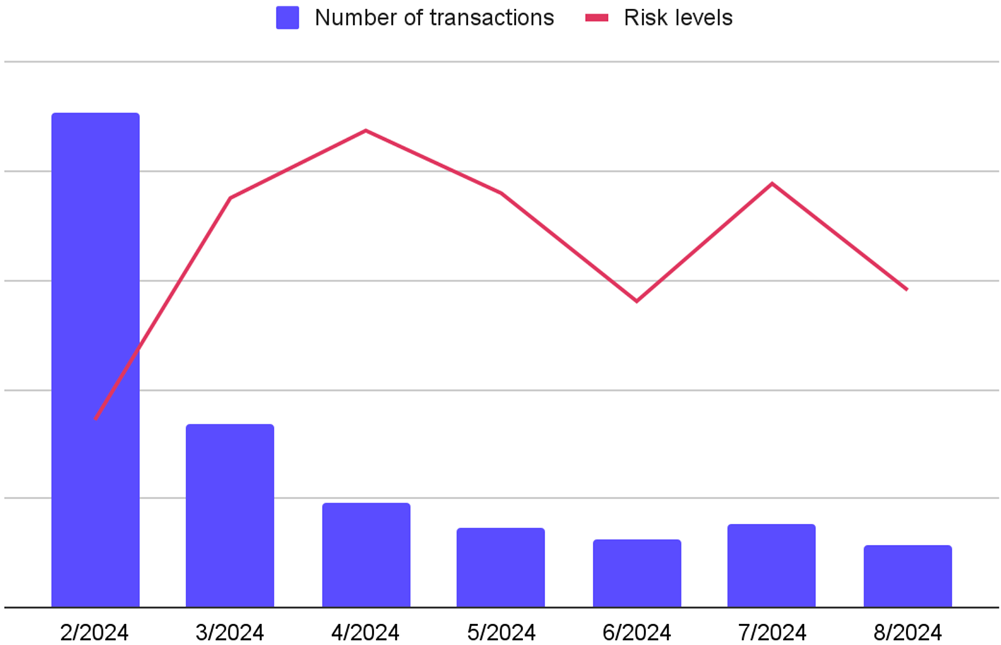
From the release date through a 6-month period.
Source: Riskified
47% of all orders were placed in February 2024, with a marquee sneaker release honoring Michael Jordan’s 61st birthday and the 2024 All-Star Weekend. Fraud risk follows the ebb and flow of inventory — underscoring how operational preparedness during high-demand events is critical.
risks afoot
Even in-person drops carry significant risks: many brands hire security guards to help control the lines that snake around multiple blocks and keep behavior in check. A highly anticipated drop in New York even required police intervention to handle a crowd full of resellers.
Risk trends
Fraud trends in the sneaker category don’t follow a static path. They vary by season, geography, and even brand — requiring merchants to adapt tactics continually. Risk volatility can tax merchant operations, overloading teams and resources.
Seasonality
Overall, the yearly average risk level in the sneakers industry decreased by ~10% from September 2023 to August 2024 compared to the previous year, but risk levels were volatile during that period.
MoM GLOBAL RISK LEVELS FLUCTUATION
Brand hotspots
Risk levels for sneaker brands shift throughout the year based on fashion trends, new releases, and seasonal sales.
- Each month, a single brand typically stands out as having the highest risk and is targeted more by fraudsters.
- Larger brands, like Nike and Adidas, while enjoying higher transaction volumes, face greater fraud exposure. One major sneaker brand consistently accounts for 70% of orders and 75% of fraudulent transactions, amplifying its risk profile compared to other brands.
Risk by payment method
Credit cards remain the most risky payment method. Among "nontraditional" options, wallets have the highest risk level, and buy-now-pay-later (BNPL) is the least risky. Fraudsters favor wallet payments because the tokenized data adds an extra layer of anonymity, making it harder to distinguish between a legitimate wallet owner and a fraudster.
Risk by region
In the United Kingdom, sneakers were the riskiest category within the fashion sector, surpassing both high-end fashion items and fast fashion in risk. In the Asia-Pacific region, sneakers topped the risk charts during the first half of the year, but high-end fashion became the riskiest category in the later months.
UNITED KINGDOM
ASIA PACIFIC
Proven strategies
Sneaker merchants need agile, intelligent fraud prevention strategies that align with customer satisfaction goals.
Automate fraud prevention
Sneaker merchants can reduce the financial, operational, and reputational toll of fraud by using AI to more accurately differentiate between fraudulent and legitimate customers and resellers at the point of purchase. With greater automation and accuracy, merchants can focus on providing great customer experiences without worrying about false declines or policy enforcement.
Adopt identity-based solutions
Riskified’s dynamic technology examines patterns at a network-wide scale. By identifying suspicious behaviors — including bots and ATO efforts — it empowers merchants to foil fraudsters.
Build an omnichannel view
An integrated, omnichannel perspective lets merchants evaluate customer behavior holistically, whether online or in-store. This clarity enables consistent fraud prevention while improving the experience for genuine shoppers across their preferred channels.
Partner with Riskified
Learn how one sneaker merchant grew online revenue and cut operational costs by automating order review with Riskified’s AI-powered fraud management and risk intelligence platform.
About this Risk Rundown
Across industries, Riskified captures and analyzes data related to orders processed through our vast merchant network. We combine our findings with exclusive research and intelligence from online fraud forums to provide merchants with category-specific insights.

Yael Hemo
Data Analyst, Data Insights team

Adi Dick-Charnilas
Senior Data Analyst, Data Insights team