


What return behavior looks like around the world
Survey data from 2,091 consumers reveals why one returns policy can't fit all and what AI is changing
Return abuse looks different depending on where your customers are. That’s one central finding from Riskified’s 2026 report, Rewriting the rules on returns, and it has direct consequences for how fraud and ecommerce teams set policy, calibrate models, and communicate with customers.
The report surveyed 2,091 consumers across seven markets and interviewed ten senior retail leaders at brands with revenues between $250 million and $10 billion. Here’s what the data shows.
No single policy works everywhere
The report surveyed consumers in the US, UK, Japan, Brazil, Singapore, Mexico, and China. Return frequency alone illustrates the scale of regional difference: 70% of Chinese consumers return items frequently or very frequently. In the US, that figure is closer to 30%. A policy calibrated for one market would be actively harmful in the other.
Social media is shaping behavior differently per market
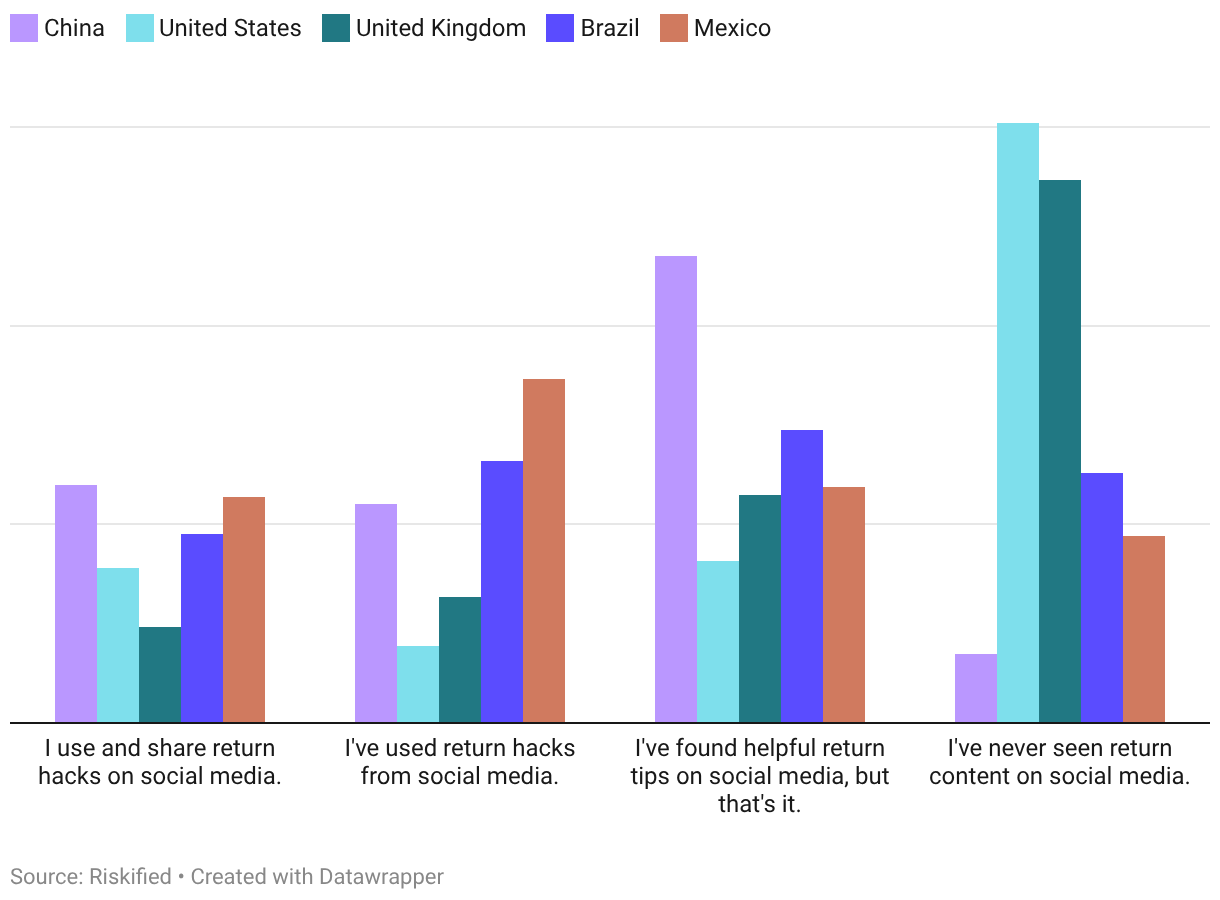
In China, 93% of consumers have encountered return-related content on social platforms—tips, tactics, and shared approaches to maximizing returns. In the US, 60% of consumers have never seen it. Brazil and Mexico sit closer to China’s end of the spectrum.
For fraud teams, that means elevated return volume in China or other similar markets isn’t just an individual behavior problem. It can be a coordinated one.
Applying the same level of aggressive monitoring in lower-exposure markets like the US and UK would generate false positives and create friction for the majority of honest customers. The sophistication of your fraud models should reflect what consumers in each market are actually doing.
AI is changing how claims are made
Nearly half of global consumers have already used generative AI tools such as ChatGPT to help with return or refund claims, in some cases with potentially fraudulent intent. As AI agent adoption grows, that figure is likely to increase. Fraud teams need to account for claims that are more polished, more persuasive, and harder to flag on language quality alone.
What “acceptable” looks like varies just as much
Beyond volume, the report asked consumers what kinds of return behavior they consider reasonable. The answers differ sharply by market.
- Japan is the conservative outlier: nearly one in four consumers reject all tested return scenarios as unacceptable, and Japan has the highest share of shoppers who prefer buying in-store specifically to avoid returns. Strict policies carry almost no reputational risk there.
- Brazil sits at the opposite end. Consumers are more likely than any other market to view wardrobing and short-term electronics use as acceptable. Tightening policies without clear communication risks appearing punitive to all customers, rather than targeted at bad actors.
- Singapore presents a specific challenge: nearly two-thirds of consumers consider it acceptable to return items that look different from online photos. For merchants in that market, part of the returns solution may sit upstream — in product photography accuracy and sizing tools — rather than purely in policy enforcement.
- The US and UK sit in the middle but aren’t interchangeable. US consumers are significantly more prone to wardrobing and item-not-received abuse than UK consumers. UK consumers, while more conservative overall, show high acceptance of bracketing (45% view buying multiple sizes and returning the rest as acceptable). Gray-area behaviors can quietly erode margins even in a market without elevated traditional fraud.
The practical implication
What counts as elevated return frequency, what behaviors trigger review, and what threshold triggers a restriction all need to be calibrated against regional baselines. A return rate that flags as unusual in Tokyo is unremarkable in Shanghai.
How you communicate policy matters, too. Over 60% of consumers globally say they would adjust their return behavior if they knew the real costs of returns. In markets where policy changes can feel punitive, transparency about why a policy exists changes how it lands.
Want the full picture?
Turns out “normal” isn’t universal.
Read Rewriting the rules on returns for the regional breakdown and consumer attitudes that will make you rethink what “normal” looks like.
