

The grinch of ecommerce
Spotting fraud & abuse amidst 2025’s AI-powered holiday shopping
A global preparedness guide for merchants
As ecommerce merchants gear up for the holiday sales season, anchored by Black Friday and Cyber Monday (BFCM), their fraud management and customer experience (CX) teams are bracing for a surge in orders and post-holiday claims, and along with it, CNP fraud and return abuse.
To guide preparations and help merchants avert chaos from the first wave of pre-holiday shopping to last-minute orders and the “Returnuary” deluge, Riskified has compiled exclusive data and timely insights.
This guide will examine key challenges from checkout to post-fulfillment, providing actionable strategies for fraud and CX managers to shine during this busy and financially crucial season.

Holiday 2025: Cautious spending, deliberate choices
Most reports suggest that consumers are bracing for higher prices this holiday season and will be more conservative and resourceful in their spending. Many will resort to gift cards as a way to stick to budgets and hedge against high prices. Consumers are also turning to AI assistants to help with their purchasing decisions.
Riskified 2025 global consumer survey:
Shoppers are embracing AI assistants like ChatGPT for generating product ideas (45%), summarizing reviews (37%), and comparing prices (32%). More than half (58%) are likely to use these tools for gift shopping this year, marking the beginning of the first truly AI-powered holiday season.
Read the full press releaseRetailers will need to innovate in this environment in order to safely and confidently embrace all types of shopping traffic, focus on value, and create superior customer experiences to compete for every dollar, euro, and real.
‘Tis the season (for fraud)
Busy shopping seasons drive spikes in demand and activity that fraudsters exploit, creating potential operational challenges and losses for merchants.
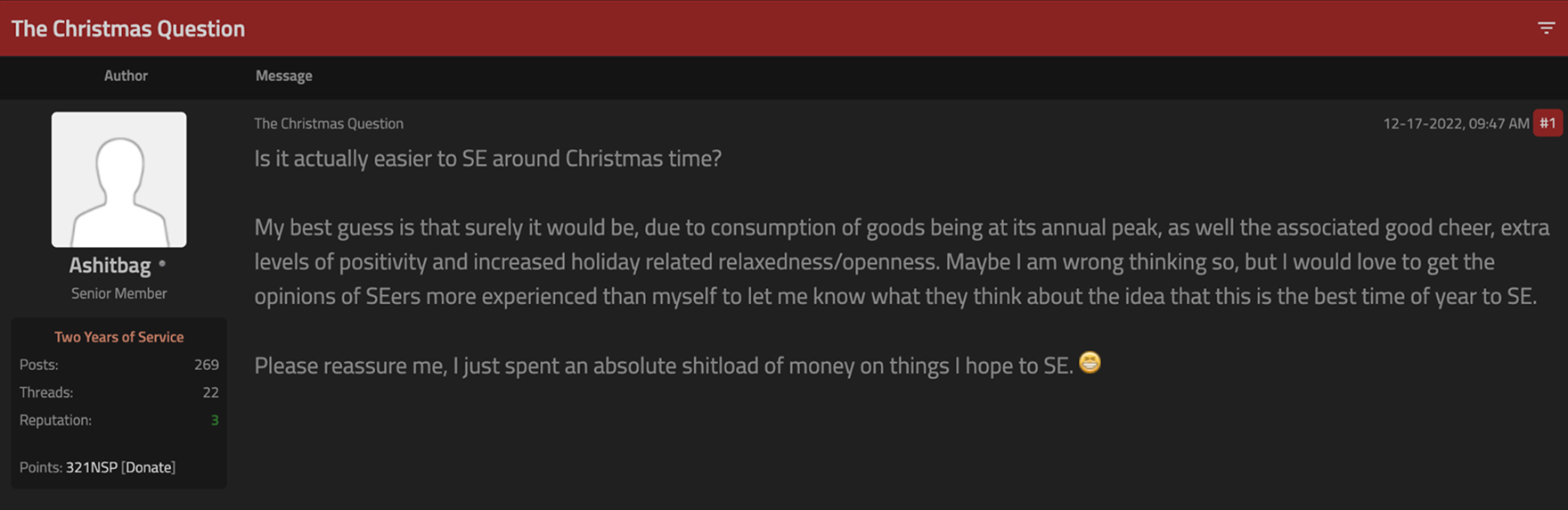
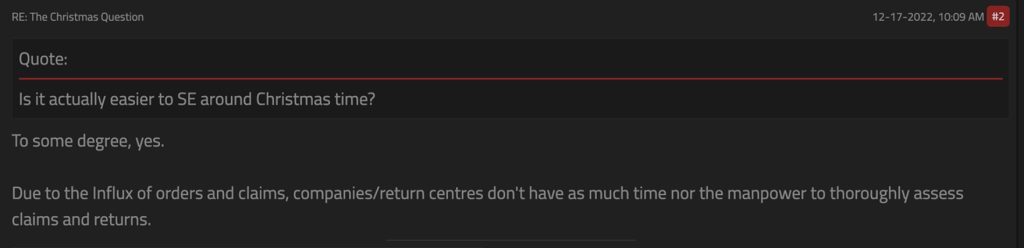
Source: Dark web
Riskified’s analysis of fraud strategies discussed on the dark web shows that fraudsters view the holiday shopping season as a prime opportunity. A significant increase in chatter related to abuse and scams occurs each year during the period surrounding BFCM and Christmas. Fraudsters believe the high volume of orders and returns during this time overwhelms retailers, making it easier for illicit activities to go undetected.
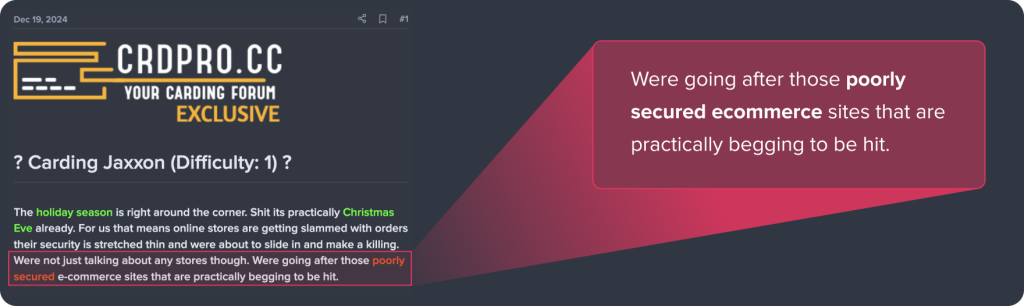
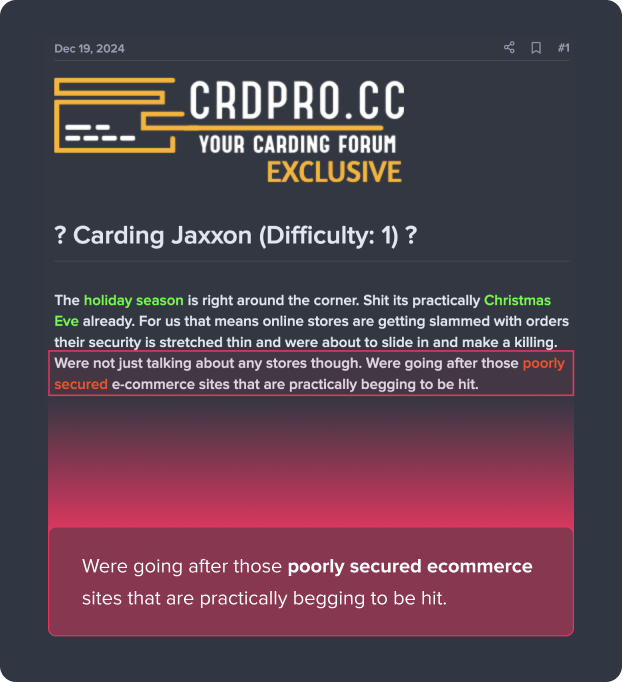
Even fraud services are on sale for the holidays
With seasonal demand high, dark web vendors are cashing in, too. Those who traffic in compromised accounts, stolen credit card information, refunding, email spamming, and other illicit services offer their own holiday-themed promos and discounts, encouraging and equipping other actors to commit fraud.
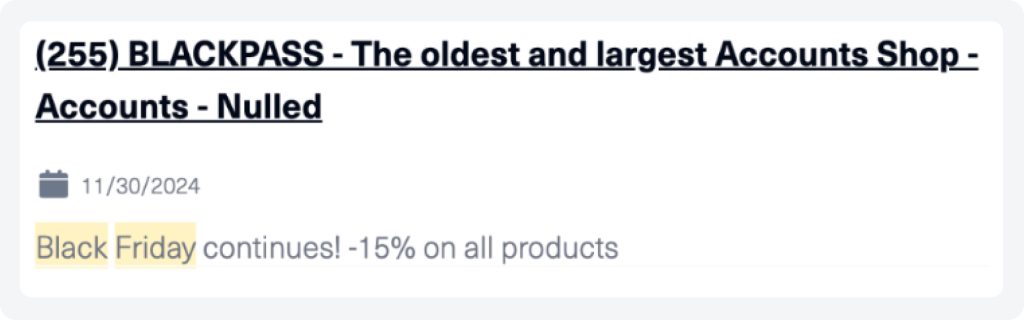
Even amateur fraudsters have unprecedented access to self-service online resources, guides, and refund services, amplifying the problem for merchants beyond professional fraud rings.
Risk trends
Carding forums on the dark web show threat actors preparing to use stolen credit card information during the holiday rush, but that’s just the tip of the fraudulent iceberg.
Riskified leverages data from across our extensive merchant network to analyze fraud trends and shopping behaviors. When we say “riskier,” we mean that these orders are statistically more likely to involve fraud or abuse. We determine this by calculating the fraud attempt rate, based on a combination of known fraud cases we’ve blocked and confirmed chargebacks. These patterns help merchants understand emerging risks, fine-tune their fraud controls, and safely capture legitimate orders.
Riskified’s analysis of order data from previous BFCM through “Returnuary” periods reveals fraud exposure throughout the season and across the customer purchase cycle.
Dilemmas at every touchpoint
Fraudsters are aware that the high-noise environment of the holidays and post-holiday “Returnuary” makes it more challenging for merchants to both detect and prevent illicit activities. The line between normal purchases and returns, and those involving nefarious activity, is blurred, creating extra complexity and risk for merchants that want to maintain a seamless experience for their good customers.
At hello
First-time customers come out in droves during the holiday season, presenting a great opportunity for merchants to establish new relationships and increase their market share. However, Riskified analysis shows that fraudsters exploit the fact that retailers may relax their usual security systems to maximize conversions.

At log-in
Log-in attempts, password resets, and other account updates increase significantly during holiday periods as shoppers stray from routines. Fraudsters exploit this by buying and using trusted accounts to bypass checks and leverage stored payment methods.
At shopping cart
Sophisticated fraudsters exploit measures that categorize physical orders and older accounts as safer. For example, deliberately adding low-value physical products to orders containing high-risk digital goods (such as gift cards).
At payment
The holiday season’s surge in transaction volume creates an ideal cover for criminals to exploit stolen credit card information, straining retailers’ fraud detection systems. With limited time to investigate every alert, merchants may overlook red flags, such as a mismatch between a card’s BIN and the shipping zip code.
At shipping
With logistics companies under pressure and legitimate consumers travelling or sending gifts to atypical addresses, merchants are more inclined to approve orders with irregular address formats or rerouting requests. Fraudsters exploit this opportunity to obtain stolen goods while concealing their true identities.
At refunds
Refund fraud is a widely discussed tactic on the dark web, particularly during the holiday season. Threat actors view the post-holiday window as a “prime refunding season” because the surge in order volume and claims tickets overwhelms less advanced CX teams that conduct manual reviews.
Holiday hustle or holiday hassle? The line gets blurry
Riskified research reveals that during the holiday season, behavioral anomalies that might typically seem suspicious can actually be entirely legitimate at every touchpoint.

Seasonal fraud by category
In this section, we delve into an analysis of transaction data from previous BFCM through “Returnuary” periods in the United States, shedding light on how fraudsters target and exploit specific categories during the holidays.
Electronics
The lucrative combination of high resale value and the constant demand for the latest technology makes electronics prime targets for fraudulent activities year-round. And during the holidays, Riskified typically sees a significant surge in both volume and fraud in the category:
- 12x – Higher daily Total Payment Value (TPV) during BFCM compared to early November
- 2.5x – Higher monthly average TPV during November-December
- 8 days – TPV begins to grow before BFCM (one day earlier YoY) and remains elevated for 20 days after the sales weekend
- 8.5x – Higher fraudulent daily TPV during BFCM versus early November
Travel and event ticketing
In travel and event ticketing, high-volume months tend to result in higher fraudulent activity. During the holiday season, Travel Tuesday is a major sales event for the flight industry. Event ticketing, strongly linked to the travel sector — especially with the growing popularity of concert-related travel — also experiences a surge. 2024 Travel Tuesday Riskified data showed:
- 70% – increase in TPV compared to the beginning of the season (starting Nov. 1)
- 26% – increase in YoY TPV for Ticket purchases
- 60% – increase in fraudulent TPV on Travel Tuesday 2024 compared to the beginning of the season (starting Nov. 1)
- 50% – increase YoY fraud attempts for flight bookings
- 10% – risk increase YoY for hotel bookings
Fast fashion
Fashion, as a whole, is a risky segment within ecommerce. While it is less vulnerable to fraud than digital industries, it still presents significantly higher risks compared to most other retail sectors. Within the fashion segment, fast fashion stands out, grappling with its own unique set of fraud challenges and tactics. Riskified research on the industry shows that risk is heavily front-loaded in the peak pre-holiday season:
- 7x – higher daily TPV during BFCM compared to early November
- 2x – monthly average TPV in November and December, beginning its rise two weeks before BFCM and staying elevated for about two weeks
- 10% – increase in customer spending per shopping session compared to the rest of the year
- 2x – higher daily fraudulent TPV between Christmas Day and January 1 compared to the season’s overall daily average
Home goods
Although home goods carry a lower risk of fraud and abuse compared to categories like consumer electronics and fashion, Riskified still sees a holiday surge in the industry that starts notably earlier than in other sectors. The prolonged period of heightened demand gives merchants an extended opportunity to fortify defenses and maximize conversion strategies:
- 2.3x – higher daily TPV during BFCM compared to early November
- 20 days – before BFCM that TPV begins to rise significantly, with daily increases of up to +60%
- 50% – increase in TPV during the holidays compared to the monthly average
Beauty
The cosmetics and beauty retail sector thrives during two holiday peaks, with major promotional events around Mother’s Day and Christmas, which help drive consumer spending. Riskified data shows:
- 2 – peak seasons in May-June and November-December
- 120% – higher TPV for November-December than the monthly average
- 36% – increase in AOV compared to the monthly average
Gift cards
Consumers love gift cards and it’s no wonder; gift cards are as good as cash. Additionally, they can be personalized for the gift recipient’s interests and preferences. They’re easy to buy, can be gifted through a physical card or digital experience, and allow the recipient to select exactly what they want. Unfortunately, they’re also a fraudster’s dream, topping the list of preferred payment methods by scammers:
- 3x – daily TPV during BFCM weekend compared to the November average
- 2.2x – holiday TPV compared to the monthly average
- 180% – increase in daily TPV on Christmas Day versus the December average, making it the peak day of the month (and 2.5x higher than during BFCM) and full year
- 170% – increase in fraudulent daily TPV on Christmas Day compared to the December average
- 80% – higher fraudulent TPV in December compared to the monthly average

Vp of Fraud Strategy at The Wolfe Companies
We have a tool that is analyzing all of it for us… it was speeding up the service to the good customer, it was eliminating fraud really fast: … return requests immediately dropped by 20%.”
Trends in other regions
Here’s how fraudsters target and exploit regional nuances during the holidays in Europe and Latin America:
Europe
Europe’s diversity of languages, currencies and payment methods creates opportunities for geo-mismatch exploitation. EU merchants experience more instances of local fraudsters targeting foreign credit cards and multiple geo-mismatches within transactions, such as BIN mismatches, language mismatches, and accounts or emails associated with foreign identities.
Legitimate shopping behaviour can resemble fraud during the holidays. Higher-velocity sales, multiple shipping addresses, unusual devices, and cross-border transactions become more commonplace.
In addition, the robust resale ecosystem in Europe amplifies the risk for sellers of monetizable goods, such as luxury fashion, gaming equipment, and gift cards.
In Europe, Riskified finds that the holidays lead to a rise in fraud associated with alternative payment methods. Meanwhile, in the luxury fashion sector, fraudsters frequently employ the tactic of sequentially targeting multiple merchants, which makes cross-merchant visibility especially important in the region.
Latin America
In Latin America, both legitimate shopping and fraudulent activities are shaped by a distinctive holiday calendar. In addition to BFCM, Mexico celebrates Buen Fin, which creates an additional sales surge from November 15 – 18.
Día de los Reyes sparks another round of gift-giving on January 6 and another opportunity for merchant risk and reward in Mexico, Colombia, Chile and Argentina.
For merchants here, the extended holiday season presents both opportunities and challenges. With these events, the region experiences prolonged periods of heightened shopping activity. This extended calendar not only boosts sales potential but also increases exposure to fraud, requiring merchants to stay vigilant and adapt their fraud prevention strategies to manage risks effectively throughout the holiday season.
Proven strategies to protect your profits and CX during every holiday moment, and beyond
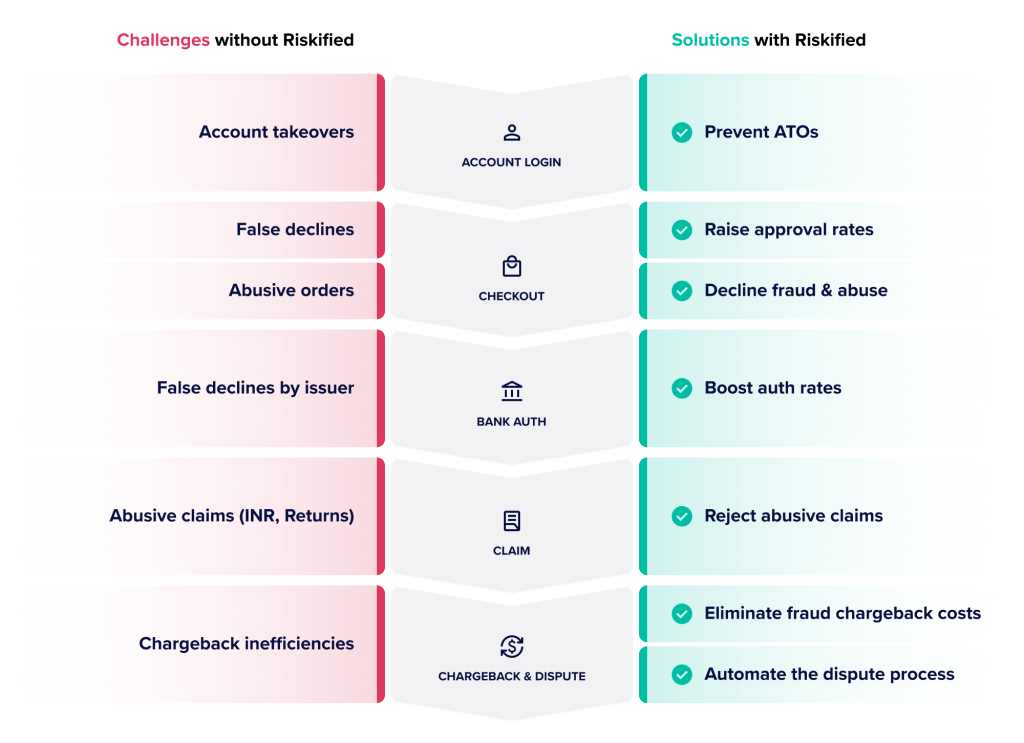
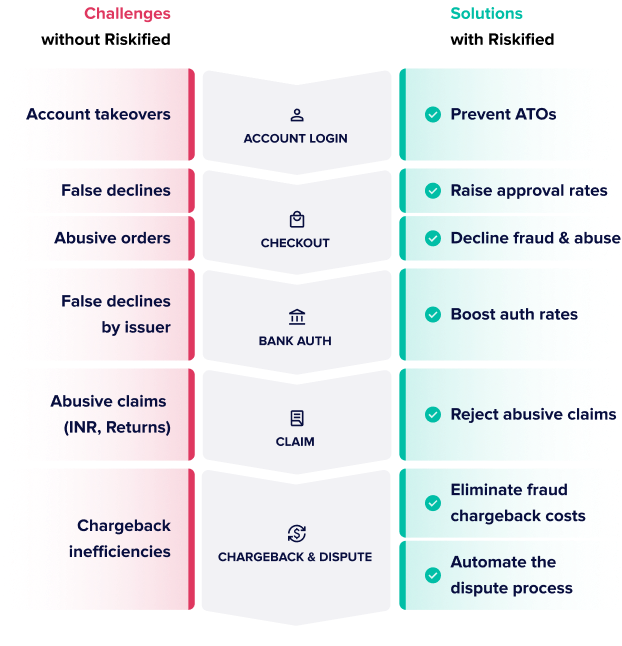
At every touchpoint during the busy end-of-year sales season, merchants can eliminate the chaos that creates vulnerability to fraud, operational overload, and potential discord with valuable customers. With identity-based data intelligence, network-wide insights, and end-to-end automation, merchants can block fraud at every step and focus on generating profitable sales and delivering positive experiences.
From blocking CNP fraud and ATOs at checkout to minimizing and then rapidly resolving returns claims and chargeback disputes, Riskified makes every holiday touchpoint better for your customers, your teams, and your profitability.
Perfect checkout with adaptive technology
Be sure you can approve every good conversion even amidst the holiday rush. With the right adaptive technology, you can identify more good orders, boost authorization rates and increase approval rates with intelligent, calibrated checkout flows.
Better authorizations can help merchants increase conversion rates without sacrificing approval rates or compromising fraud prevention. Blocking fraud during checkout also alleviates downstream CX burdens post-order fulfillment.
Leverage the network
Fraudsters have long exploited the lack of visibility across merchants and digital businesses. Technology that examines patterns at a network-wide scale across diverse retailers can disambiguate these patterns and better assess the identity behind suspicious behaviors, including ATOs.
A networked approach creates an inhospitable environment for fraud and fosters a more favorable space for growth-positive commerce, especially during peak shopping seasons. With Riskified’s global merchant network, even customers who are new to you are likely already known to our network:
- 85% of new customers at retail merchants have external links to orders from other Riskified merchants
- 19 average number of externally linked orders
- 5 have externally linked merchants on average
As you gear up for peak shopping and return season, this guide will help you strike the right balance between speed, trust and protection in the refund process.
Automate returns and disputes
Merchants can reduce the financial and operational toll of return abuse by using AI to quickly and accurately differentiate between fraudulent and legitimate customers at the point of purchase and during claims processing.
With greater automation and accuracy, merchants can focus on providing great customer experiences and flexible returns without worrying about a deluge of returns abuse.
Similarly, better chargeback dispute management can dramatically improve processing speed and recovery rates. Merchants can automate evidence compilation and submission to scale revenue recovery without added effort.
Stay pro-customer in “Returnuary,” not just anti-fraud
A good customer experience in this peak season can pay off in year-round loyalty and repeat sales. Empowering CX teams with AI-driven data intelligence allows them to instantly identify and approve low-risk claims, reduce wait times, and improve repurchase rates. To reduce operational strain, providing AI-enabled options for tasks such as checking order status and initiating returns can be particularly beneficial for merchants whose customers have expressed comfort with using AI for these activities:


Adapt safely to agentic commerce
The same Riskified survey revealed a defining moment for ecommerce: nearly three in four shoppers (73%) are already using AI in their shopping journey. Shoppers are embracing AI assistants like ChatGPT for product ideas (45%), to summarize reviews (37%), and to compare prices (32%). And more than half (58%) are likely to use these tools for gift shopping this year, marking the beginning of the first truly AI-powered holiday season, where convenience for consumers may come with heightened exposure for merchants who will often bear the liability for this uncharted domain.
Through strategic partnerships, innovative technology, and enhanced infrastructure, Riskified is empowering merchants with the ability to distinguish between malicious and legitimate AI shopping agent traffic. Its three solutions interweave a security infrastructure built on the foundation of Riskified’s expertise in fraud prevention and ecommerce enablement, delivering precise decisions and improved business performance for merchants.
Partner with Riskified
For over a decade and through each holiday season, Riskified has empowered merchants worldwide to improve approval rates, decrease chargeback rates, safeguard against fraud rings and bots, and significantly reduce costs, all while enhancing customer experiences.
Conclusion
About this guide
Across regions, Riskified captures and analyzes data related to orders processed through our vast merchant network. Findings are combined with exclusive research and intelligence from online fraud forums and merchant interactions to provide our community with the most relevant insights available.

Lev Gal
Senior Data Analyst, Data Insights team

Yael Hemo
Data Analyst, Data Insights team
